The way you look tonight, with golden hair
Cascading 'round your face and gazing eyes
That meet mine own in a most intense stare,
Makes my heart soar and my spirits rise.
Your lashes, which fringe oval pools of light
That transcend towards my soul's inner depths
And illuminate the shadows with bright,
Flutter, and shallow my every breath.
The lips, which are channels to sweetest sounds,
Are of the faintest red, and end with hints
At hidden thoughts. Within myself abounds
An air of calm, and all the world makes sense.
With you, I know my search is complete,
And I'll be o'erjoyed, if ever we meet.
Monday, December 17, 2012

Friday, December 14, 2012
Authority vs. Power: An Investigation into Character Relationships in The Tempest

In Act I of "The Tempest", Shakespeare clearly illustrates the differences between power and authority through the characters of Prospero and Ariel. Prospero, the ex-Duke of Milan and the protagonist of the novel, rescues Ariel, a spirit, from a long period of imprisonment caused by an evil witch's spell. Because his salvation is ultimately indebted to Prospero, Ariel becomes Prospero's servant until Prospero chooses to grant him freedom. As a result, Ariel turns into a sort of supernatural minion, executing Prospero's every request. Ariel uses his magical powers from beyond the grave to do everything for Prospero, from shipwrecking a vessel of Prospero's enemies to becoming a nymph that leads Prince Ferdinand to fall in love with Miranda, Propero's beloved daughter. Through this relationship, Shakespeare demonstrates that while power is the ability to influence the outcome of events and actions of people, authority is the right to do so through a legitimate social position. Ariel has the power to perform amazing feats and paranormal acts, but does not possess the authority to justify them. In contrast, Prospero has authority over everyone on the island, through patriarchal or divine right, and can order anyone to do anything at anytime, but he lacks the power to succeed in anything on his own. Shakespeare further utilizes these two characters to emphasize that authority, in most cases, subjugates and trumps power.
An additional example of a power versus authority role that would support the previous assertion is that of Alonso, the King of Naples, and Prospero. Alonso, the authority figure in this relationship, abuses his leadership position in ousting Prospero from power in favor of a dishonest, though profitable, offer from Prospero's brother, Antonio. Though Prospero technically has the civil support, or power, necessary to retaliate, he backs off for the time being, because he does not have the legitimate means to go up against a divine figure. This further suggests that power is a useful tool, but that the authority to engage the power of others is more desirable.
Sunday, November 11, 2012
Life of Pi: A Literary Gem
Yann Martel's novel, Life of Pi, is widely revered as a classic of the modern age. Its creative plot line and captivating voice serve to ignite the readers imagination while delving into a plethora of humanity's questions about religion, candor, and the natural world.

The story relates the life of a young boy, and the interesting experiences he has on a seemingly unfeasible adventure. The boy, Piscine Molitor Patel, grows up in Pondicherry, India, with his older, more popular brother, Ravi. Their parents own and run a local zoo, and Piscine, called Pi to avoid the harrows of peer inflicted, name jokes, is constantly immersed in a world of animals and exotic cultures. At a young age, he becomes fascinated with the concept of organized religion, and questions whether or not his faith, Hinduism, is really the right denomination for him. As a result, Pi explores the world of worship, becoming members to both a Christian church and an Islamic synagogue while retaining Hindu loyalties, all at the utter disbelief of his family and religious leaders. The conflicting nature of his pursuits only serves to confuse and motivate him further. When Indian nationalist Mahatma Ghandi is murdered, and political upheaval ensues, the Patel family decides to sell their property and most of the zoo animals, and hightail it for Canada, where they believe a better life awaits. They board a passenger ship, and begin the voyage northwest. However, not even a few days into the journey, Pi awakens to a loud, ominous noise in the middle of the night, and sneaks out of his family's cabin to investigate. On the deck of the boat, he sees the crew running around in a panicked frenzy, screaming in foreign, Asian tongues, and unlocking the cages of the few animals his family had brought with them. One of the crewmen spots him and tosses him overboard, amongst an array of animals also fleeing the ship, and onto a lifeboat, where he finds himself in the company of a weeping hyena and a zebra with a broken leg. As he watches the ship sink, and realizes that he is the only person that has successfully escaped, he sees an old friend, Richard Parker, struggling to stay afloat. Without hesitation, Pi calls attention to his acquaintance and throws out a life line, failing to even stop and consider the potential gravity of his actions. When his acquaintance finally jumps onboard, Pi fearfully realizes the danger of what he has just done: he has just willingly saved the live of a Bengal tiger, India's greatest predator, and is now contained with it within the constraints of a small life boat. The rest of the tale conveys Pi's struggles for survival against not only nature, but also the brute force of his lifeboat companions and existence of his own will to survive the hardships he endures.
Martel's literary creation is one of marvelous originality, impressive capacity for reader connection, and immense insight into human perceptions of faith. This novel is a must read masterpiece that can be enjoyed by most ages and will, no doubt, endure the tests of time. I am eagerly awaiting the release of it's film counterpart, which will be released this Wednesday, November 14.
Photo made possible by http://www.filmofilia.com/new-life-of-pi-clip-121493/
Thursday, November 1, 2012
Rationalization in Frankenstein: Justifying the Wrong Decision
Rationalization, or a justification of disapproving thoughts or actions, plagues the minds of all individuals. It often prevents people from doing what they know is right, for they are able defend their own selfish, inappropriate, and cruel conduct through persuading themselves in favor of their behavior. In fact, when presented with a pressing situation, if one does not make the decision choose the ethical or honorable pathway within 6 seconds, he will lose himself to his rationalization. For example, in psychologist Stanley Milgram's experiment, obedience to an authority figure, as it pertains to following unethical or immoral orders, was tested. Participants were recruited to administer electric shocks to unseen patients at the direction of a tall, commanding man in a white lab coat. A majority of the shock administering participants sent shocks of dangerous magnitude to the patient in the next room, even when they the patient screamed for mercy or stopped communicating altogether. The shock administering participants then justified their inhumane actions, claiming that since they were only following orders, they were not responsible for any consequences. This experiment clearly demonstrated the negative effects of rationalization on the human conscience.
In addition, rationalization also afflicts Frankenstein's mind when he talks himself out of confessing who William's true murderer is. Even though the life of innocent Justine Moritz, beloved and dedicated house maid, is on the line for supposedly killing little William Frankenstein, Victor refuses to come forward and reveal the identity and essence of the actual criminal. He rationalizes that if he came forth to claim that a monster he created with his own two hands was his own brother's murderer, he would be deemed a madman by his family, his friends, the court, and the citizens of Geneva. Frankenstein also believes that no one would acknowledge the credibility of his declaration. So, to preserve his reputation and sanity, he restrains himself, and watches a poor, innocent, heart-broken girl be condemned for a crime she would never even dream of committing. This rationalization also serves to signify a pattern of fault within Victor: his mind continues to be is biggest enemy, for he convinces himself to create life for the controversial sake of science but talks himself out of saving a girl's life. If Victor had been denied the ability to rationalize, the novel Frankenstein would no longer be considered a tragedy.
Monday, October 29, 2012
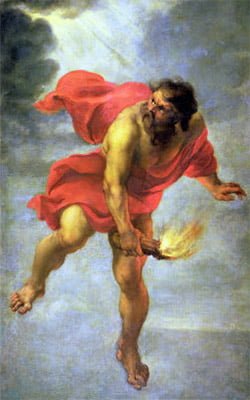
Frankenstein: "The Modern Prometheus"
In the novel Frankenstein, which author Mary Shelley herself even subtitled "The Modern Prometheus," there are many allusions to the mythological character Prometheus, who the Greeks credit with the formation of human life from inanimate material. In Romantic works of writing, Prometheus typically represents the solitary intellectual who works to improve life on Earth, usually through a quest for scientific intelligence, and suffers some misfortune as a consequence of his research. In Frankenstein, Victor becomes consumed with his scientific quest, and dedicates all of his efforts to trying to create life from dead or decaying human body parts. Victor overextends his capabilities so much so that he cuts himself off from the rest of the world, neglecting to write even his dear friends and family, and drives himself mad with ambition. When he finally succeeds in creating "the monster," he realizes the horrible reality of what he has done, and acknowledges the demise to which his life is now permanently bound.


Above: Prometheus; Bottom: Victor Frankenstein as portrayed by Gene Wilder
Young Frankenstein also submits to hubris, or actions that degrade and dishonor subjects for personal gain, during his experiments to create human life from nonliving material. Victor admits that "a churchyard [is to him] merely the receptacle of bodies deprived of life, which, from being the seat of beauty and strength,
ha[ve] become food for worm"(46). He "spend[s] days and nights in vaults and charnel houses"(46), dissecting the bodies of the dead, which, at the time, was considered an utmost vulgar, disgusting, and sinful crime. Grave robbing and ripping apart corpses, though often for anatomical study and scientific gain, was condemned during the Romantic era. In fact, human corpse mutilation has been regarded as unlawful and heretic for centuries, which is why Victor's physiology studies are conducted in secret.
Images provided by:
http://www.greekmyths-greekmythology.com/wp-content/uploads/2009/08/prometheus-fire.jpg
http://profile.ak.fbcdn.net/hprofile-ak-prn1/23156_1785102291_4581_n.jpg
Above: Prometheus; Bottom: Victor Frankenstein as portrayed by Gene Wilder
Young Frankenstein also submits to hubris, or actions that degrade and dishonor subjects for personal gain, during his experiments to create human life from nonliving material. Victor admits that "a churchyard [is to him] merely the receptacle of bodies deprived of life, which, from being the seat of beauty and strength,
ha[ve] become food for worm"(46). He "spend[s] days and nights in vaults and charnel houses"(46), dissecting the bodies of the dead, which, at the time, was considered an utmost vulgar, disgusting, and sinful crime. Grave robbing and ripping apart corpses, though often for anatomical study and scientific gain, was condemned during the Romantic era. In fact, human corpse mutilation has been regarded as unlawful and heretic for centuries, which is why Victor's physiology studies are conducted in secret.
Images provided by:
http://www.greekmyths-greekmythology.com/wp-content/uploads/2009/08/prometheus-fire.jpg
http://profile.ak.fbcdn.net/hprofile-ak-prn1/23156_1785102291_4581_n.jpg

Sunday, October 14, 2012
The Most Bizarre College Essay Question
In an application to Oklahoma State University, which I filled out this weekend, I was asked to create a poem, consisting of 250 words or less, that included the words clock, Wild West, bicycle, and duct tape. Could this prompt be any stranger? This is what I concocted:
A clock measures time on the width of its face,
The face of the earth’s a miraculous place,
If the clocks are turned back to long, long ago,
We could witness a wonder, a Wild West Show.
Cowboys and natives would parade on their steeds,
Performing many an incredible deed.
But we could turn time further back, if you like,
To pedal the first “dandy horse,” called a bike.
Riding with Parisians, under the Eiffel,
Bicycles and Frenchmen would hail your arrival.
But crossing the Pont Neuf, right over the Seine,
You would think of another bridge, in Brooklyn.
Up to1902, we would then travel,
To see the Brooklyn Bridge, raised from the gravel.
We would ascend its height, if we are able,
And notice duct tape, rapped ‘round every cable.
Seeing the binding would remind us of home,
Where tape fixes all, from broke glasses to combs.
We would turn time forward, to twenty-thirteen,
And embrace our own place, despite all that we’d seen.
(If you’re wondering if this poem is true,
historically accurate, with nothing skewed,
my answer is yes, and each stanza is fact,
based on true events, and perfectly exact.)
Thursday, September 27, 2012
Eden: An Original Poem
Beyond the reach of man’s destructive grasp,
Far from the outskirts of humanity,
There is a meadow.
Nestled tightly in God’s hands,
Cradled within His gentle grasp,
It is shared with all who care enough to open their eyes.
Not just to see, but to experience,
To appreciate, to feel the blessed serenity.
If you really see, nature’s beauty
Takes its true form.
Its rivers soothe your soul,
Its skies ignite hope,
Its winds whisper to you.
A secret, a secret to you alone.
The words bring a smile to your lips,
And you feel separated from yourself,
But connected to the earth.
You let your gravity slip away
As you become one with the meadow... Suspended in His hands.
Wednesday, September 26, 2012
Frankenstein: Classism, Alchemy, and Romanticism
In chapters one and two of Frankenstein, Victor Frankenstein acknowledges the existence of classism in explaining the fallen state of his mother, Caroline Beaufort, and revealing how his family acquired his adoptive sister, Elizabeth Lavenza. However, this social distinction does not seem to act as a barrier to Frankenstein or his family. Though Frankenstein's father can identify that Caroline Beaufort has lost everything, including her place in high society, he acts as if this social barrier is nonexistent. He goes to great lengths to rescue her from penury, after a short period of time, marries her, thus dedicating the rest of his life to sheltering her from hardship and compensating for what she has suffered. In addition, after Caroline is married and regains membership to the upper class, she fails to really recognize classism, and any perceived societal obstacle is impotent. She maintains a close connection to the lower classes, because she can relate to their circumstances, and frequently visits homes much more humble than her own with the sole intention of benevolence. In fact, the Frankenstein family's humanitarianism and ignorance to any sort of social division is most evident in their adoption of Elizabeth, an impoverished orphan, and their treatment of her as a complete equal to their own biological son.
Alchemy plays a huge part in the early studies of Victor Frankenstein, and is largely responsible for heightening his interests in science, particularly those sciences deemed heretical and unorthodox. Although alchemy can refer to the fashioning of a special stone that can change natural elements into precious metals, young Frankenstein's fascination with the concept relates more to another of its objectives: "the elixir of life". Through the literature of Agrippa, he becomes acquainted with the darker, more mystical and controversial aspects of alchemy, but he immediately throws these aside upon his discovery of the works of Paracelsus. Paracelsus possessed a more logical approach to alchemy, especially as it pertained to the concept of immortality, and emphasized the utilization of minerals and chemicals to treat the human body. This particular direction of Frankenstein's studies serves to foreshadow his future obsession with synthetically creating life, the actualization of which causes his own demise.
In chapter two, Victor Frankenstein mentions that his playmate, Henry Clerval, has an obsession with romantic novels. I found this quite ironic because, in fact, the novel Frankenstein itself is a work of romantic literature. The Romanticism movement focused on the rejection of the Industrial Revolution and Enlightenment, and instead advocated to sustain a sort of medievalism. In romantic literature, the protagonist is often a social outcast, as is Victor Frankenstein, and there is an evident presence of women and children, hence the large influence of Caroline and emphasis on Frankenstein's enjoyable childhood. Romantic novels also highlight a preoccupation with terror, ergo the creation of the monster, and the existence of a scenic setting, such as the protagonist's home on the lovely Lake Geneva.
Alchemy plays a huge part in the early studies of Victor Frankenstein, and is largely responsible for heightening his interests in science, particularly those sciences deemed heretical and unorthodox. Although alchemy can refer to the fashioning of a special stone that can change natural elements into precious metals, young Frankenstein's fascination with the concept relates more to another of its objectives: "the elixir of life". Through the literature of Agrippa, he becomes acquainted with the darker, more mystical and controversial aspects of alchemy, but he immediately throws these aside upon his discovery of the works of Paracelsus. Paracelsus possessed a more logical approach to alchemy, especially as it pertained to the concept of immortality, and emphasized the utilization of minerals and chemicals to treat the human body. This particular direction of Frankenstein's studies serves to foreshadow his future obsession with synthetically creating life, the actualization of which causes his own demise.
In chapter two, Victor Frankenstein mentions that his playmate, Henry Clerval, has an obsession with romantic novels. I found this quite ironic because, in fact, the novel Frankenstein itself is a work of romantic literature. The Romanticism movement focused on the rejection of the Industrial Revolution and Enlightenment, and instead advocated to sustain a sort of medievalism. In romantic literature, the protagonist is often a social outcast, as is Victor Frankenstein, and there is an evident presence of women and children, hence the large influence of Caroline and emphasis on Frankenstein's enjoyable childhood. Romantic novels also highlight a preoccupation with terror, ergo the creation of the monster, and the existence of a scenic setting, such as the protagonist's home on the lovely Lake Geneva.
Subscribe to:
Comments (Atom)