Monday, October 29, 2012

Frankenstein: "The Modern Prometheus"

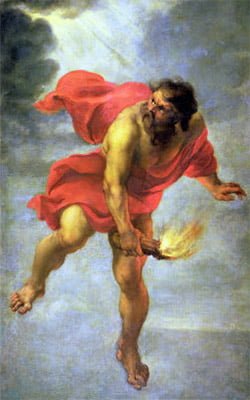
In the novel Frankenstein, which author Mary Shelley herself even subtitled "The Modern Prometheus," there are many allusions to the mythological character Prometheus, who the Greeks credit with the formation of human life from inanimate material. In Romantic works of writing, Prometheus typically represents the solitary intellectual who works to improve life on Earth, usually through a quest for scientific intelligence, and suffers some misfortune as a consequence of his research. In Frankenstein, Victor becomes consumed with his scientific quest, and dedicates all of his efforts to trying to create life from dead or decaying human body parts. Victor overextends his capabilities so much so that he cuts himself off from the rest of the world, neglecting to write even his dear friends and family, and drives himself mad with ambition. When he finally succeeds in creating "the monster," he realizes the horrible reality of what he has done, and acknowledges the demise to which his life is now permanently bound.

  
Above: Prometheus; Bottom: Victor Frankenstein as portrayed by Gene Wilder


Young Frankenstein also submits to hubris, or actions that degrade and dishonor subjects for personal gain, during his experiments to create human life from nonliving material. Victor admits that "a churchyard [is to him] merely the receptacle of bodies deprived of life, which, from being the seat of beauty and strength,
ha[ve] become food for worm"(46). He "spend[s] days and nights in vaults and charnel houses"(46), dissecting the bodies of the dead, which, at the time, was considered an utmost vulgar, disgusting, and sinful crime. Grave robbing and ripping apart corpses, though often for anatomical study and scientific gain, was condemned during the Romantic era. In fact, human corpse mutilation has been regarded as unlawful and heretic for centuries, which is why Victor's physiology studies are conducted in secret.


Images provided by:
http://www.greekmyths-greekmythology.com/wp-content/uploads/2009/08/prometheus-fire.jpg
http://profile.ak.fbcdn.net/hprofile-ak-prn1/23156_1785102291_4581_n.jpg

Sunday, October 14, 2012

The Most Bizarre College Essay Question

In an application to Oklahoma State University, which I filled out this weekend, I was asked to create a poem, consisting of 250 words or less, that included the words clock, Wild West, bicycle, and duct tape. Could this prompt be any stranger? This is what I concocted:


A clock measures time on the width of its face,
The face of the earth’s a miraculous place,
If the clocks are turned back to long, long ago, 
We could witness a wonder, a Wild West Show.

Cowboys and natives would parade on their steeds,
Performing many an incredible deed.
But we could turn time further back, if you like,
To pedal the first “dandy horse,” called a bike.

Riding with Parisians, under the Eiffel,
Bicycles and Frenchmen would hail your arrival.
But crossing the Pont Neuf, right over the Seine,
You would think of another bridge, in Brooklyn.

Up to1902, we would then travel,
To see the Brooklyn Bridge, raised from the gravel.
We would ascend its height, if we are able,
And notice duct tape, rapped ‘round every cable.

Seeing the binding would remind us of home,
Where tape fixes all, from broke glasses to combs.
We would turn time forward, to twenty-thirteen,
And embrace our own place, despite all that we’d seen.

(If you’re wondering if this poem is true,
historically accurate, with nothing skewed,
my answer is yes, and each stanza is fact,
based on true events, and perfectly exact.)